The short biography
The woman who maps arrivals.
Mara Vale draws the lines that tell a city how to move. Her official maps are precise, patient things: every transfer named, every walking distance tested, every dead end made legible. Her private maps are harder. They live on the backs of envelopes, in the folds of old atlases, and once—during the year documented here—under the cutlery drawer.
She grew up three bus stops from Larkspur Court with her younger brother, Tom. Their father drew roads from memory. Their mother made a thin lemon soup whenever somebody came home late. Years later, after both parents were gone and the family apartment had been sold, Mara rented 4C because its kitchen window faced the same water tower.
She said the apartment was temporary. The sink disagreed almost immediately.
The absent five years
Before the first observation, Mara lived elsewhere with a partner who preferred new cups, closed windows, and a kitchen that revealed nothing. The relationship ended without spectacle. What remained was a reluctance to buy food in quantities larger than one and the habit of turning handwritten notes face-down.
She returned to Larkspur Court in September with three boxes. One held clothes. One held maps. The third held the blue cup: chipped at the lip, dark as evening, and once Tom's. She placed it on the highest shelf and did not use it for five months.
The year in the sink
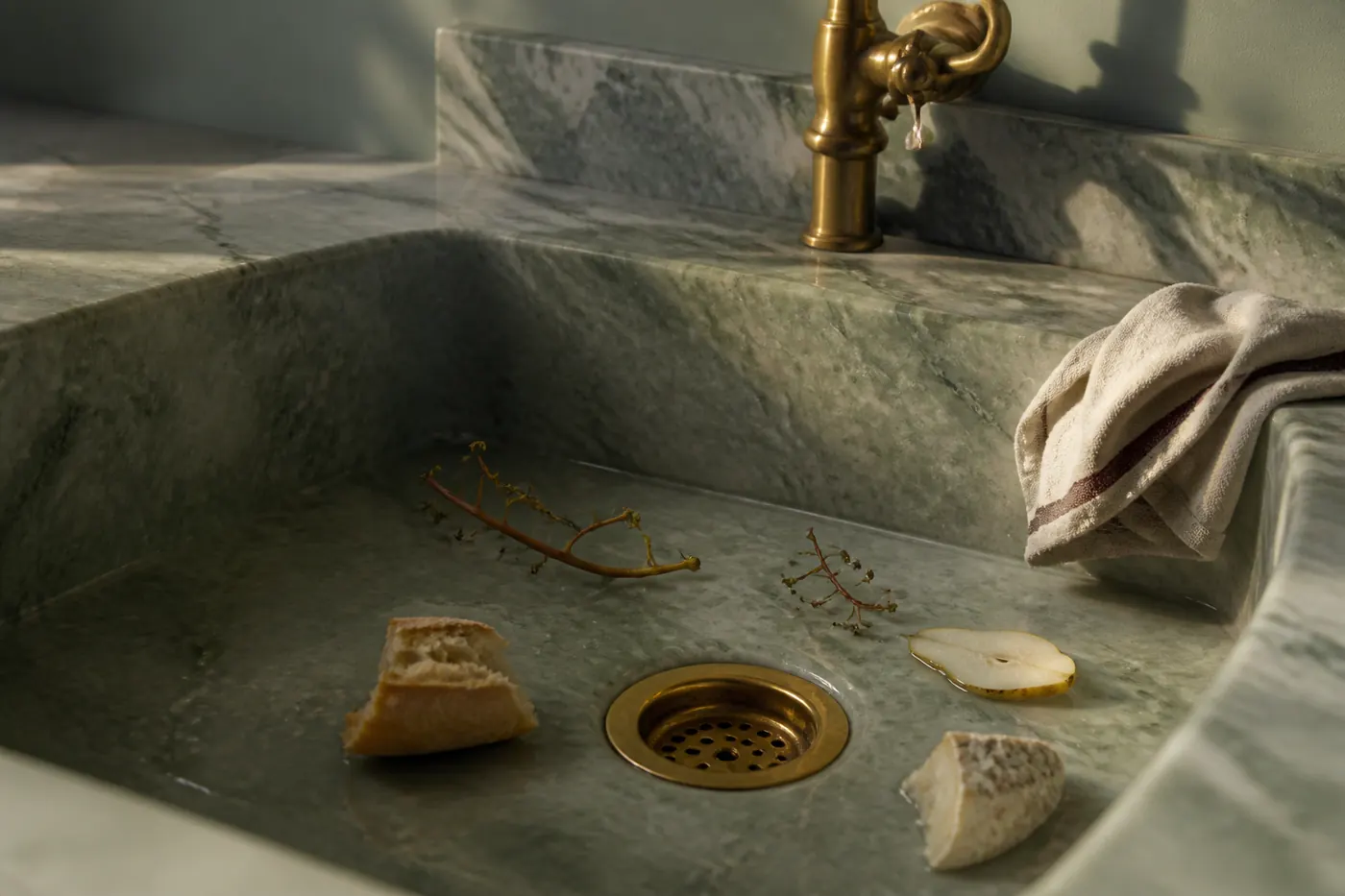
The early traces are nocturnal and spare—toast corners, noodle loops, tea leaves allowed to darken. In winter, herbs begin to appear. By February, a second bite mark arrives. By April there are two eggs' worth of shell in the basket and the blue cup is on the counter.
We do not claim that chives prove reconciliation, or that a hash brown can certify forgiveness. We do observe that domestic change often registers at the edges: a second spoon, a larger strainer catch, a crumb pattern no single diner could plausibly make.
The blue cup
Tom gave Mara the cup when he was fourteen and she left for university. It appeared at every apartment that followed, always clean, rarely used. During chapter eight, it enters the sink with a crescent of tea foam at its base. That is the first direct sign that the visitor has been invited to stay long enough for tea.
The cup is absent from the final observation because it is still on the table.